Linear Regression

Linear Regression models the relationship, more specifically the correlation between two or. more variables and as such, we will see how to plot them to look for these relationship models.

import pandas as pd
import matplotlib.pyplot as plt

# Import the housing information for analysis 
housing = pd.DataFrame.from_csv('../data/housing.csv', index_col=0)
housing.head()

# Use covariance to calculate the association
housing.cov()

# Use correlation to calculate the association is more appropriate in this case
housing.corr()

# scatter matrix plot
from pandas.tools.plotting import scatter_matrix
sm = scatter_matrix(housing, figsize=(10, 10))

# This time we take a closer look at MEDV vs LSTAT。 What is the association between MEDV and LSTAT you observed?
housing.plot(kind='scatter', x='LSTAT', y='MEDV', figsize=(10, 10))

Simple linear regression

yi=β0+β1∗xi+ϵi

# lets try to guess what are the real values of intercept and slope
# we call our guess b0, b1...
# Try to assign the value of b0, b1 to get a straight line that can describe our data 
b0 = 0.1
b1 = 1
housing['GuessResponse'] = b0 + b1*housing['RM']

# Also want to know the error of of guess...
# This show how far is our guess response from the true response
housing['observederror'] = housing['MEDV'] - housing['GuessResponse']


# plot your estimated line together with the points
plt.figure(figsize=(10, 10))
plt.title('Sum of sqaured error is {}'.format((((housing['observederror'])**2)).sum()))
plt.scatter(housing['RM'], housing['MEDV'], color='g', label='Observed')
plt.plot(housing['RM'], housing['GuessResponse'], color='red', label='GuessResponse')
plt.legend()
plt.xlim(housing['RM'].min()-2, housing['RM'].max()+2)
plt.ylim(housing['MEDV'].min()-2, housing['MEDV'].max()+2)
plt.show()

Validate Models

  • Linearity
  • Independence
  • Normality
  • Equal Variance

Normality Validation – Use QQ plot

import scipy.stats as stats
import matplotlib.pyplot as plt
z = (housing['error'] - housing['error'].mean())/housing['error'].std(ddof=1)

stats.probplat (z, dist='norm'm plot=plt)
plt.title('Normal QQplot')
plot.show()

Perform OLS regression based on the model

// SPY regressed on predictor on number of exchanges 
formula = 'spy~spy_lag1+sp500+nasdaq+dji+cac40+aord+daxi+nikkei+hsi'
lm = smf.ols(formula=formula, data=Train).fit()
lm.summary()

We can measure the performance of our model using some statistical metrics – RMSEAdjusted R2�2

Kotlin Coroutines

This page is dedicated to Kotlin Coroutines, given the magnitude of the coverage.

Let’s check out the features…

Coroutines are more natural asynchronous routines

  • Looping constructs, yield control/cooperation are natural
  • Provides context for suspended functions
  • Exception handling is more sequential/natural
  • Scalability is easier
  • Mobile async development is easier
  • Non-preemptive multi-tasking

The below code shows two variations of starting threads, note that coroutines are lighter threads and completes far quicker and also don’t take too much of the CPU core’s scheduling.

import kotlinx.coroutines.*
import java.lang.Thread.sleep
import java.util.concurrent.atomic.AtomicInteger
import kotlin.concurrent.thread
import kotlin.system.measureTimeMillis
import kotlin.time.measureTime

const val num_tasks = 10000
const val loops = 500
const val wait_ms = 10L


fun main() = runBlocking {

    thread_main()

}

// normal thread - Doesnt completes and takes bit longer
fun thread_main() {

    println("Starting...")

    val result = AtomicInteger()
    val threads = mutableListOf<Thread>()

    val elaspedTime = measureTimeMillis {
        for (i in 1..num_tasks) {

            threads.add(thread {
                for (x in 1..loops) {
                    sleep(wait_ms)
                }
                result.getAndIncrement()
            })
        }

        threads.forEach { it.join() }
    }

    println("Result, ${result.get()} in ${elaspedTime} msecs")
}

// coroutine threads - Completes on my m/c 21 secs
 suspend fun  coroutine_main() = coroutineScope {

    println("Starting...")

    val result = AtomicInteger()
    val threads = mutableListOf<Job>()

    val elaspedTime = measureTimeMillis {
        for (i in 1..num_tasks) {

            // Threads not launched from main thread
            threads.add(launch(Dispatchers.IO) {
                for (x in 1..loops) {
                    delay(wait_ms)
                }
                result.getAndIncrement()
            })
        }

        threads.forEach { it.join() }
    }

    println("Result, ${result.get()} in ${elaspedTime} msecs")

}
  

Coroutines are built using coroutine builder aka runBlocking which provides a bridge between main / non-suspend vs suspend functions.

runBlocking is coroutine builder that blocks the main threads until all the code within it finishes.

Coroutines provides Job (similar to Future), can be used to join, wait, cancel etc.,.

fun main() = runBlocking {

    val job = launch {
        delay(1000)
        println("World")
    }
    println ("Hello..")
    job.join()
    println("Done")
}
// cancel job

@OptIn(ExperimentalTime::class)
fun main() = runBlocking {

    val elapsedTime = measureTime {
        val job = launch {
            repeat(1000) {
                delay(10)
                println(".")
            }
        }

        delay(250)
        // Note cancel will be called coroutine delay which is built in function that will
        // cooperate to cancel the job
        job.cancel()
        job.join() // or job.cancelAndJoin()
    }
    println("Done in ${elapsedTime} secs")
}
// Timeout handling
fun main() = runBlocking {


    val job = withTimeoutOrNull(100) {

        repeat(1000) {
            yield()

            println(".")
            Thread.sleep(1)
        }

    }

    if (job == null) {
        println("Timeout...")
    }

}

coroutineScope – create parallel launches and waits until all the jobs are completed.

fun main() = runBlocking {

    launch {
        coroutineScopeTest()
        println("Finished.")
    }

    println("Done")

}

suspend fun coroutineScopeTest()  {
    coroutineScope {
        launch {
            delay(1000)
            println("First task completed")
        }

        launch {
            delay(2000)
            println("Second job completed")
        }
    }

    println("Task completed")
}

Dispatchers – determine which thread coroutine can run on…

  • Default (Runs on Fork/Join pool – CPU bound)
  • Main (Runs on Main thread)
  • IO (IO thread pool)
  • Other (custom, JavaFX, ..,)
// Create own dispatcher and use them launch the jobs
fun main() = runBlocking{

    val dispatcher = Executors.newFixedThreadPool(4).asCoroutineDispatcher()

    val job = launch(dispatcher) {
        println("Running in thread, ${Thread.currentThread().name}")
    }

    job.join()
    println("Done")
    
    dispatcher.close()
}

CoRoutine withContext – used within suspend function

fun main() = runBlocking{

    // Coroutine Contexts - withContext
    val dispatcher = Executors.newFixedThreadPool(1).asCoroutineDispatcher()
    val job = launch(dispatcher) {
        println("Calling with thread, ${Thread.currentThread().name}")
        doWork()
    }

    job.join()

    println("Done")

}

suspend fun doWork() {
    withContext(Dispatchers.IO) {
        println("Dispatcher IO running in thread, ${Thread.currentThread().name}")
    }
}

Kotlin

Here are some tips on this new wonderful language…

  • if statement can be an assignment, as every operator is a function within Kotlin, so for instance,
val message  = if ( a== b) "True" else "False"
println (message)

Null Safety

By default, references cannot be assigned to null, Kotlin will throw compile time error.

To make an object reference hold null, we need to explicitly state, something like a question mark which indicates to the compiler that the reference can take on null values

var answer:String? = null

class Book {
  var title: String
}

val book:Book? = Book()
book?.title = "Group"

When Statement

Kotlin introduces powerful when operator, which acts like switch but can type reference, so something like,

val correctAnswer = "42"
var answer = "42"

when(answer) {
  CorrectAnswer -> println("Correct answer")
   else -> println("Something else")
}

Try/Catch

val number:Int = try {
  parseInt(someNumber) } catch(e: NumberFormatException) {
  null
}

println("The result is $number")

For Loops

// Declare ranges for not just numbers, anything Comparable
var rangea = 'a' ..'z'
var inRange = 1..10

for(i in 10 downTo 1 step 2) {
  println(i)
}

for(i in 1..10 step 2) {
  println(i)
}

for( i in 1 until 10) { // doesnt include 10, 
  println(i)
}

//List
var numbers = listOf(1,2,3,4,5)
for( i in numbers) {
  println(numbers)
}

// For loop with index
for((index, element) in numbers.withIndex() {
  println("$index = $element")
}

//Map
var ages=TreeMap<String, Int>[]
ages['Kevin"] = 55
ages["Sam"] = 24
for((name, age) in ages) {
   println("$name = $age")
}

Functions

Calling from Java

// Create package class and functions, Program.kt

@file:JvmName("DisplayFunctions")

package orm

fun display(message): String {
  println(message)
}

// Now from within the Java class, Test.java

import orm.*;

public class Test {

  public static void main(String args[]) {
    System.out.println(DisplayFunctions.display("Hello from Java");
  }

}

Functions can use default parameter

fun display(message:String, logLevel: Int = 0) {
  println(message)
}

For calling from Java, add annotation
@JvmOverloads
  println(message)
}

// Now this function can be called from Java with/without logLevel

Named Parameters

Extension Functions

// Functions can be added to existing classes, essentially static functions
// 1. Cut down on utility classes
// 2. Code easier to read

fun main() {
  val text = "Replace    text  tt. of. this "

  // Normal usage of function call
  println(replaceWithRegex(text))

  // Extension usage
  println(text.replaceWithRegex())

}

fun replaceWithRegex(value:String) : String {
  val regex = "\\s+"
  regex.replace(value, "")
}

// Two changes:
// 1. Add class that needs extension, in this case, String prefix'd to the function name
// 2. Remove the method arg, replace with this
fun String.replaceWithRegex() : String {
  val regex = "\\s+"
  regex.replace(this, "")
}

Infix Function

data class Header(val name: String) 

infix fun Header.plus(other: Header) : Header {
  return this.name + other.name
}

h1, h2, h3: Header

h3 = h1 plus h2

// Also support operator overloading

operator infix Header.plus(other: Header) : Header {
  .....
}

// Now, this can be called as

h3 = h1 + h2

Tail Recursive

// Famous Fibonacci Series

tailrec fun fib(n:Int, a:BigInteger, b:BigInteger) : BigInteger = {
  if (n == 0) b else fib(n-1, a+b, a)
}

Interfaces

  • Default Methods
  • Properties
interface Time {

  fun setTime(....)

  // default method
  fun time() = { ....
   }

// Diamond interface problem

interface A { fun doSome() = { } }
interface B { fun doSome() = { } }
class Foo : A,B = {
  override fun doSome() = {
    super<A>.doSome()
  }
}

Class Construction

open class Person(val name: String) {
  val name: String
  init {
    this.name = name
  }
}

open class Person(val name: String) {
  val _name = name
}

open class Person(val name: String)

// Overloaded constructors
open class Person(val name: String) {
  constructor class Person(name: String, age:Int) : this(name) 
}

// Class extending base class
class Student(name: String) : Person(name)

class Student: Person {
  constructor(name: String) : super(name)
}

class Student ; Person() 

Data Classes

Immutable Classes

Provides, Equals, Hashcode, ToString

Kotlin provides copy methods

data class Meeting (val name: String, val location: String)

val aMeeting = Meeting("Yepp", "London")
val aaMeeting = aMeeting.copy(location = 'New York")

Object Classes

‘object’ classes are used the same as a class but they don’t have a constructor, essentially providing Singleton type instantiation

  • Create Singletons
  • Derive from classes
  • Implement interfaces
  • Can be created inside class

data class Course(val id:Int, val name: String)

object Courses {

    var allCourses = arrayListOf<Course>()

}

class Grad(firstName: String, lastName: String, tutor: String) {

    fun enrole(courseName: String) {

        Courses.allCourses.add(Course(1, courseName))
        
       val courses = Courses.allCourses.filter { it.id > 0 && it.name == courseName}.firstOrNull()

    }

}

Companion Object

Essentially companion object provides static methods & interfaces for the enclosing classes, and annotate with @JvmStatic if main method wants to be called from outside, for instance

class Program {
  companion object {
    @JvmStatic
    fun main(args: Array<String>) {
      println("Hello")
    }
  }
}

High Level Functions

  • Functions as first class
  • Can pass to and from functions
  • Can store in collections
fun main() {

    val fibCalc = fib(11, object: Process {
        override fun execute() {
            println("Inside execute...")
        }
    })

   
}

interface Process {
    fun execute()
}

fun fib(item:Int, action: Process) {
  // fibonacci calculation
}
// Lambda style invoking the functions
fun main() {

    // using lambda style

    val fibCalc1 = fib(11) { s -> println(s)  }

    val fibCacl2 = fib (11) { println(it) }

    val fibCalc3 = fib(11, ::println)
}

interface Process {
    fun execute(item:String)
}

fun fib(item:Int, action: (String) -> Unit) {
  // fibonacci calculation
}

Closures

Kotlin lambdas can mutate values


fun main() {
    
    var total  = 0;
    
    // Note within closure, field can be mutated
    // unless in Java, it has to be declared final.
    fib(11, { it -> total+it })
}


interface Process {
    fun execute(item:String)
}

fun fib(item:Int, action: (Int) -> Unit) {
    // fibonacci calculation
}

with and apply functions

class Meeting(var meeting: String, var from : LocalDate, var addOns: List<String>) {

    fun create(): Meeting {
        return Meeting("hello", LocalDate.now(), arrayListOf())
    }
}

fun main() {

    var m:Meeting = Meeting("", LocalDate.now(), listOf())

    with(m) {
        meeting = "New Meeting"
        from = LocalDate.now()
        addOns = arrayListOf("Test")
    }
    
    m.apply {
        meeting = "New Meeting"
        from = LocalDate.now()
        addOns = arrayListOf("Test") 
    }.create()
}

Kotlin Collections { Filter, Map, FlatMap}

Infinite Collections

  • Sequences – same as streams in Java
  • Lazily evaluated
  • Prefer to normal collections
  • Java 8 streams arent available on Andriod*
fun main()  {

    val meetings = listOf<Meeting>(
        Meeting(1, "A"),
        Meeting(2, "B")
    )

    meetings.asSequence()
        .filter { it.name == "A" }
        .map { it.id }
        .forEach { println(it) }
}

Kotlin <-> Java InterOperable

Java Code

public interface Created {

    public void onCreate(User user);
}

public class User {

    private final String name;


    public User(String name) {
        this.name = name;
    }

    public void create(Created created) {
        created.onCreate(this);
    }

    @Override
    public String toString() {
        return "User{" +
                "name='" + name + '\'' +
                '}';
    }
}

Kotlin -> Java Callback

fun main() {

    val user = User("Raghu Ram")

    user.create{ println ("user $it has been created")}

}

Nullability

  • Supports nullable types
  • Only explicit variables can be null
  • By default, variables are non-null

To decalre null variable, declare

val m:Meeting?

// Need to use nullable checks on method invocation
// Safe call (?.)
m?.close()

Elvis Operator

val newMeeting = m?:Meeting()

Safe Cast

val saveable = o as? ISavable

Not-Null Assertions

// Asserts that m is not null, if null NPE at operator is used
m!!.close()

let assertion for nullable types

// m is nullable type, compiler will allow to call the underlying non-nullable method, onyl when
// m is not null
m?.let {
  closeMeetingNonNull(m)
}

lateinit

class Meeting {

  // Note it's not initialized and using lateinit to inform compiler it will be initilialized
  lateinit var address: Address

  fun init(addr: Address) {
    address = addr
   }

}

Java <-> Kotlin : @NotNull, @Nullable

Java Class

class Meeting {
 private String title;

  public void addTitle(@NotNull title) {
    this.title = title
  }

  @Nullable
  public String getTitle() {
    return title;
  }
}

Kotlin code:

fun main() {
  val meeting: Meeting? = Meeting()
  meeting.addTitle("Some value");

  // Not allowed
  meeting.addTitle(null)

  // Can be null
  println(meeting.getTitle())
}

Kotlin Collections

  • Collections can be Nullable
  • Hold Null Values
  • Read-only or Mutable
  • Interop with Java
  • Arrays within Collections
Arrays can be created with
  - arrayOf
  - arrayOfNulls
  - Array() function

  - IntArray
  - ByteArray
  - CharArray
  - etc

 -- Provides same functions on Arrays same as Collections

High Order Functions

val action: () -> Unit = { println("Hello, World") }
val calc: (Int, Int) -> Int = { x: Int, y -> Int -> x * y }

inLine Functions

Used to substitute inline functions, add the command inline before the function name

Generics

// Generics Methods
fun <T> List<T>.itemAt(ndx: Int) : T {
  return this[ndx]
 }

// Generics Class
class Node<T>(private val item:T) {
  fun value(): T {
    return item
  }
}

Kotlin can remember the reified information at runtime using this command

inline fun <reified T> foo(value: Any) = value is T

inline fun <reified T> List<*>.typeOf() : List<T> {
  val returnList = mutableListOf<T>()

  for (item in this) {
    if (item is T) {
      returnList.add(item)
    }
  }
}

Co and contra variance Generics

// Note, need to use 'out', so to inform comopiler that no changes will be done to the 
class AllMeetings<out T:Meeting> (val meetings: List<Meeting>) {
  val count: Int get() = meetings.count()

  operator fun get(i: Int) = meetings[i]
 }

fun attendMeetings(meetings: AllMeetings<Meeting>) {
  ....
}

fun main() {
  var financialMeeting: FinanceMeeting = ...
  attendAllMeeting(financialMeeting)
}

Option Greeks

We will discuss some intuitive talks on the pricing options and option greeks.

First delta, which is first order approximation of option pricing greek and used as tool to infer probability of the option expiring in-the-money.

For a call option, delta of 0.55 denotes it has 55% of prob expiring ITM

For a put option, delta of -0.35 denotes it has 35% of prob expiring ITM

Position Theta:

Value of the portfolio with dollar amount of theta (extrinsic value) decrease over one day holding everything constant.

DevOxx Java

Don’t blindly replace ConcurrentHashMap with Hashmap for implementing concurrency in java collection maps, as this will still have the underlying concurrency problem if the get,check,act pattern is followed.

  1. Therefore, follow to replace first HashMap with ConcurrencyHashMap.
  2. Replace get,check,act with more built-in atomic methods such as “computeIfPresent” etc., wherein the atomicity is guaranteed and thread safety of the unit of work across several threads will be synchronized without loss of the adding synchronized keyword which will revert the performance of the Concurrency collections.

Swap Rates from Implied forward and Spot Rates

I will give an overview of the swap rates and how this is constructed from the implied forward and spot rates.

First, we need Depo’s and EuroDollar futures which are liquid and exchange traded instruments from which the O/N, T/N, S/N, 1M, 3M, 6M, 9M, 12M rates can be formed. Eurodollar instruments yields the futures rates and applying this with the convexity, we can then derive the implied forward rates.

Now to the next section, we need to price swap, lets say 1Y2Y swap. First, we need to get the 2 year swap rate for which we need to value both legs to zero. The answer is the “average” of the first two years of the forward curve, specifically the sequence of forward rates on 3-month LIBOR.

In general market makers set the bid and ask rates on over-the-counter (OTC) derivatives such as forwards and swaps based on the cost and risk of the most efficient way of hedging risk. When available, actively traded futures contract offer the best hedge. Note that main difference between forward and futures is settling arrangement. Whereas forward are settled as per contract agreement on the expiry dates, futures are daily settled and margins accrued typically every day.

forward_t = futures_t - \frac{1}{2} \sigma T_1 T_2

Why is the forward interest rate lower than the otherwise comparable futures rate? The key is that the gains and losses on an OTC forward contract are realized in a lump sum at the delivery date.

Stochastic Modelling of Volatility

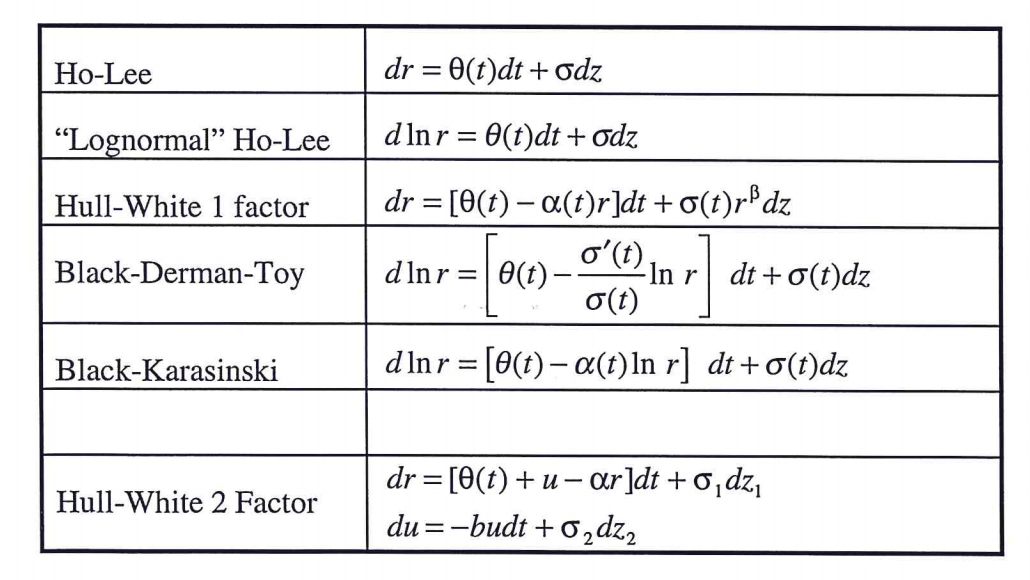
There are many stochastic volatility modelling approaches that fit each use cases for instance, DD (displacement diffusion) is used modelling inflation, CEV (constant elasticity of variance) used modelling FX, interest rates, LMM, SABR etc., There isn’t one model that fits all. Therefore trader needs to make judgement based on the market forecast and implied prices how he/she perceives the future and uses the appropriate model to quote the price and hedge the risk. Note that pricing is easy, as one can always take the market quoted prices and calibrate given model to replicate the plain vanilla prices. But most important aspect of any good modelling theory is how well it implies the future hedging cost, as therefore predicts if not accurately but approximately the future slope of the underlying asset movement.

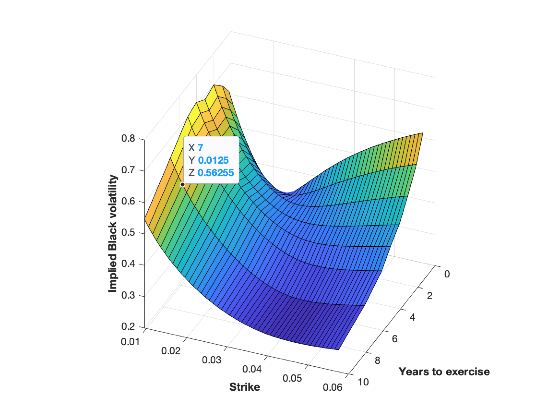
We will discuss one such model, proposed in early 2002 by Hagan et all, SABR, called Stochastic Alpha Beta and Rho model. This model is proposed to alleviate the dynamics of local volatility model which was proposed by Dupire, Derman and Kani which while calibrates today’s plain vanilla option prices perfectly but wrongly predicts the dynamics of future smile.

The original SABR model shifts the underlying, hence the delta risk changes which is improved by Bernlett’s new improved SABR model. We will see below how to include the new modified delta and vega risk.

SABR ATM vol, sigma_{ATM} is given by,

\sigma_{ATM} = \frac{\alpha_0}{f^{1-\beta}}\{ 1 + [\frac{(1-\beta)^2}{24}\frac{\alpha_0^2}{f^{2-2\beta}}  + \frac{\rho \beta \nu \alpha_0}{4 f^{1-\beta}}  + \frac {2 -3\rho^2}{24} \nu^2] T \}

Ito’s Partial Differential Equation

We will derive the Ito’s PDE for lognormal process and derive the solution.

Suppose given process A_t follows geometric brownian motion under \textbf{P} pricing measure,

dA_t = \mu A_t dt + \sigma A_t dW_t

The same process under \textbf{Q} pricing measure given by,

dA_t = r A_t dt + \sigma A_t dW_t

Now, let’s suppose we have process,

dX_t = a(X_t, t) dt + b(X_t, t) dW_t

Let’s suppose, we have Y_t = g(X_t, t)

By Ito’s process, we know that,

dY_t = \frac{dg}{dt} + \frac{dg}{dX} X_t + \frac{1}{2} \frac{d^2g}{dX^2} (dX_t)^2

Now, we from brownian motion properties, dt^2 = 0, dW dt = 0, dW^2 = dt . Applying them,

dY_t = \frac{dg}{dt} + \frac{dg}{dt}(a(X_t, t)dt + b(X_t, t) dW_t) + \frac{1}{2} \frac{d^2g}{dt^2} (b^2 (X_t, t)dt)

Now, since we know Y = ln A_t , therefore, \frac{dg}{dx} = \frac{1}{X}, \frac{d^2g}{dX^2} = \frac{-1}{X^2} . We now apply,

dY_t = \frac {1}{A} dA + \frac{1}{2} {-1}{A^2} (dA)^2

dY_t = \mu dt + \sigma dW_t - \frac{1}{2} \sigma^2 dt

dY_t = (\mu - \frac{1}{2} \sigma_2) dt + \sigma dW_t

Now, integrating now RHS,

Y_t = Y_0 + (\mu - \frac{1}{2} \sigma^2) dt + \sigma dW_t

We know that Y_t = ln(A_t) , so applying, we get the final derivation,

A_t = A_0 + exp ( (\mu + \frac{1}{2} \sigma^2) dt + \sigma dW_t )